A Beginner's Guide to Playing D&D Online
September 25, 2026
So, you want to play Dungeons & Dragons.
Maybe you've watched Critical Role, seen clips on YouTube, stumbled across D&D memes, or watched your friends talk about their latest adventure. Maybe you've even bought a set of dice and have absolutely no idea what you're supposed to do with them. You're not alone, a bunch of people started their first Dungeons & Dragons adventure this way. You decided your interested in joining this incredible hobby, and that alone is a huge step in joining a fantasy world full of adventures.
There's just one problem:
You don't have a group.
Don't worry though! It's the year 2026 and there is a huge community of people who are dealing with the same exact problem and have turned to playing their favorite TTRPGs online instead of traditionally at a table with friends. Due to covid and lack of interest by some, the online (VTT) Virtual Tabletop market really blew up and brought a ton of people together over virtual tables and Discord calls. It may feel like it's really hard to find a group right now, but that's why Chef's Dungeon was created. It all started cause chef didn't have anyone locally to play Dungeons & Dragons with. In this article, we're going to teach you everything you need to know to get started as a new player joining online D&D.
Get ready, cause your next adventure is closer than you think!
How Does Online Work? | Required Setup | Whats a VTT? | Free or Paid
How does Online D&D Work?
Dungeons & Dragons, the short version, is a tabletop roleplaying game where you and a group of other players create a story together. When you are playing online, you're using a web browser to connect to what we call (vtt) virtual tabletop to emulate being at a real table. The dungeon master will also setup a Discord server where there will be text chat areas and voice channels for sessions. The only difference between at a real table and virtual is expensive miniture models are traded for digital maps and everyone talks using gaming headsets instead of talking over a table.
Before you get too excited about joining your first game, there are some things we'll need to tell you. Dungeons & Dragons or any ttrpg is a social game where you will need to talk to other people. At first, these people are most likely going to be complete strangers. After 3 years of being a dungeon master I've seen some of the most shy people and some of the most social ones too. It's a bit harder for a shy person to join an online game but the biggest thing you need to remember if you land in this situation is to try your best to involve yourself in what's going on. As hard is it is to believe, chef too, is a shy person before d&d. I remember always playing the back-end support character for like a year but not giving up. My group constantly realizing I needed to just get out of this shy state of mind and would put me into really awesome situations where I got to speak up and shine within the party. Point is, don't let being shy ruin d&d.
Step 1: Learn some basics about Dungeons & Dragons
There's a lot of information and resources available for a player just getting started with Dungeons & Dragons. With the internet
and local game store being accessible, you almost have limitless options. If you don't have a local game store near by, you can still
find what you need online. Stores are nice cause you get to talk to people working the counter and possibly end up finding a local game
while trying to gather the things you're going to need to get started.
Please keep in mind that not everything is a must. You can literally start playing with no knowledge at all with some dungeon masters. It
really depends on how good your dungeon master is at teaching, and if they're willing to teach an absolute beginner. Some campaigns just are
not designed for beginners. But we're going to cover how to find the right game later.
You should take advantage of all the stuff i've gathered below and start the process of learning the basics. But, you don't have to if I'm being honest.
You can bookmark this page and come back later using all the searching that I did for answers as references when you come across questions or just want to
learn about something. The possibilities within Dungeons & Dragons are endless and you'll always learn new things.
- 5th Edition (2024)
- 5th Edition (2014)
- 4th Edition (2008)
- 3.5 Edition (2003)
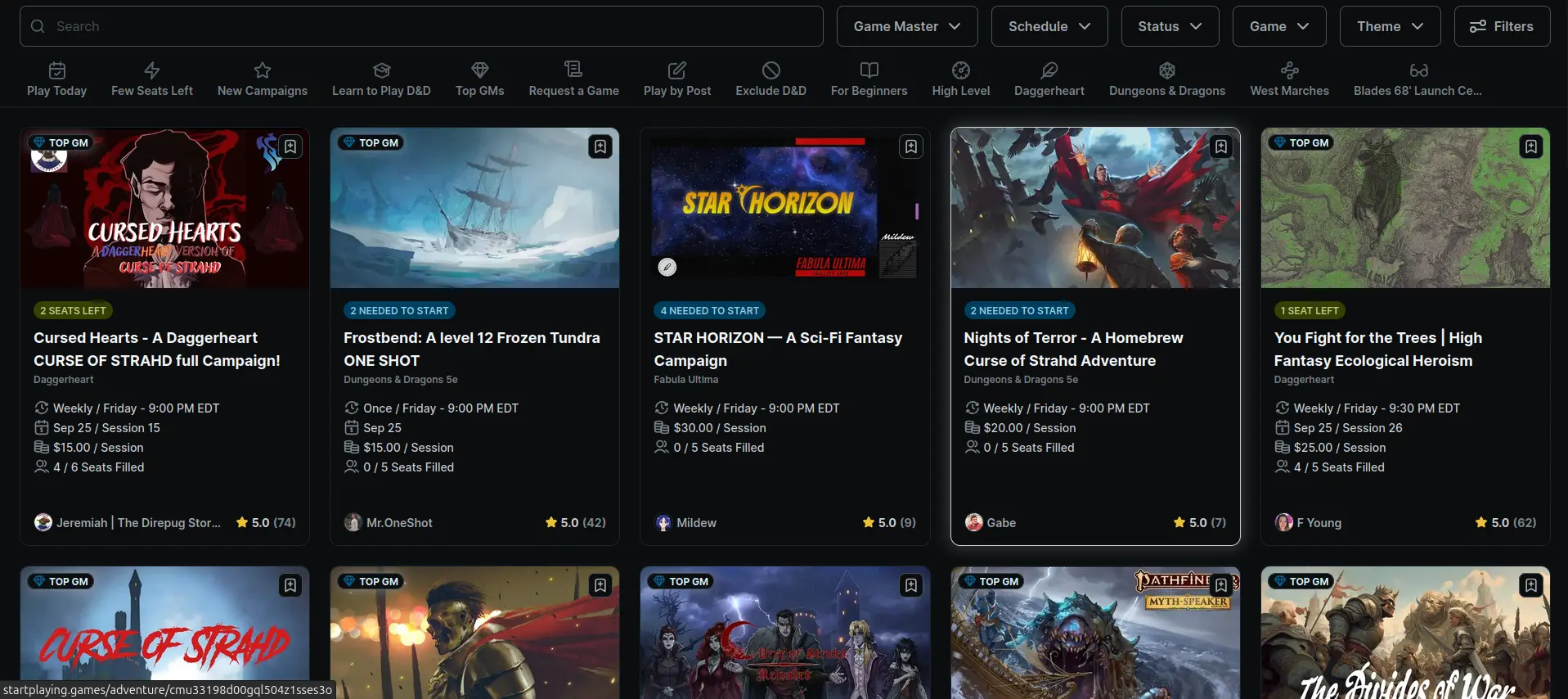
There's honestly a ton of resources out there for finding people hosting a game of Dungeons & Dragons. Discord servers, Facebook groups, Reddit, Twitter (x), and the list goes on. There are just so many places to list that we really can't do it here. Just go to any social media platform and search dungeons & dragon online and you'll find a people trying to promote their online ttrpg services. Wether it be free or paid, they're out there trying to find players so they can start their next campaign. Just look at our games, I bet there are open seats and posts across the internet with us trying to fill them. We'll give you a few locations to start your search but seriously, there are just so many places that we would have to make an entire blog post covering where to find a game online because of the amount of options we'd have to cover.
- WEBSITES
- Startplaying.games
- D&D Beyond
- Roll20 LFG
Google Online D&D and I'm sure you'll find games that way too!
This is probably the most exciting step of Dungeons & Dragons when you're first getting started. There's all these options and choices that you get. You are basically creating your dream video game and/or fantasy character with some minor limitations called the rules of Dungeons & Dragons. But even with those rules, the options feel endless sometimes. But let's not forget that we cannot let that worry us either. With all those options becomes some stress over what to choose. Honestly, you can make a very bad build, hate it, intentionally die, and come back as something you like better once you've figured out the game. People do it all the time, but you need to talk to your dungeon master about wanting a character change.
Actually, we need to cover that part too! The biggest step in character creation is talking to your dungeon master. If your using startplaying, most of the time the adventure listings have a ton of information on them. Some of that information is character rules & restrictions. So if you're trying to play an artificer or dhampire at my table, you'd want to look over my character rules first. Every dungeon master is different though because where there are things I wouldn't approve, another dungeon master might say yes to it. So don't be afraid to talk to the dungeon master and your party and ask questions. You never know what will happen til you ask.
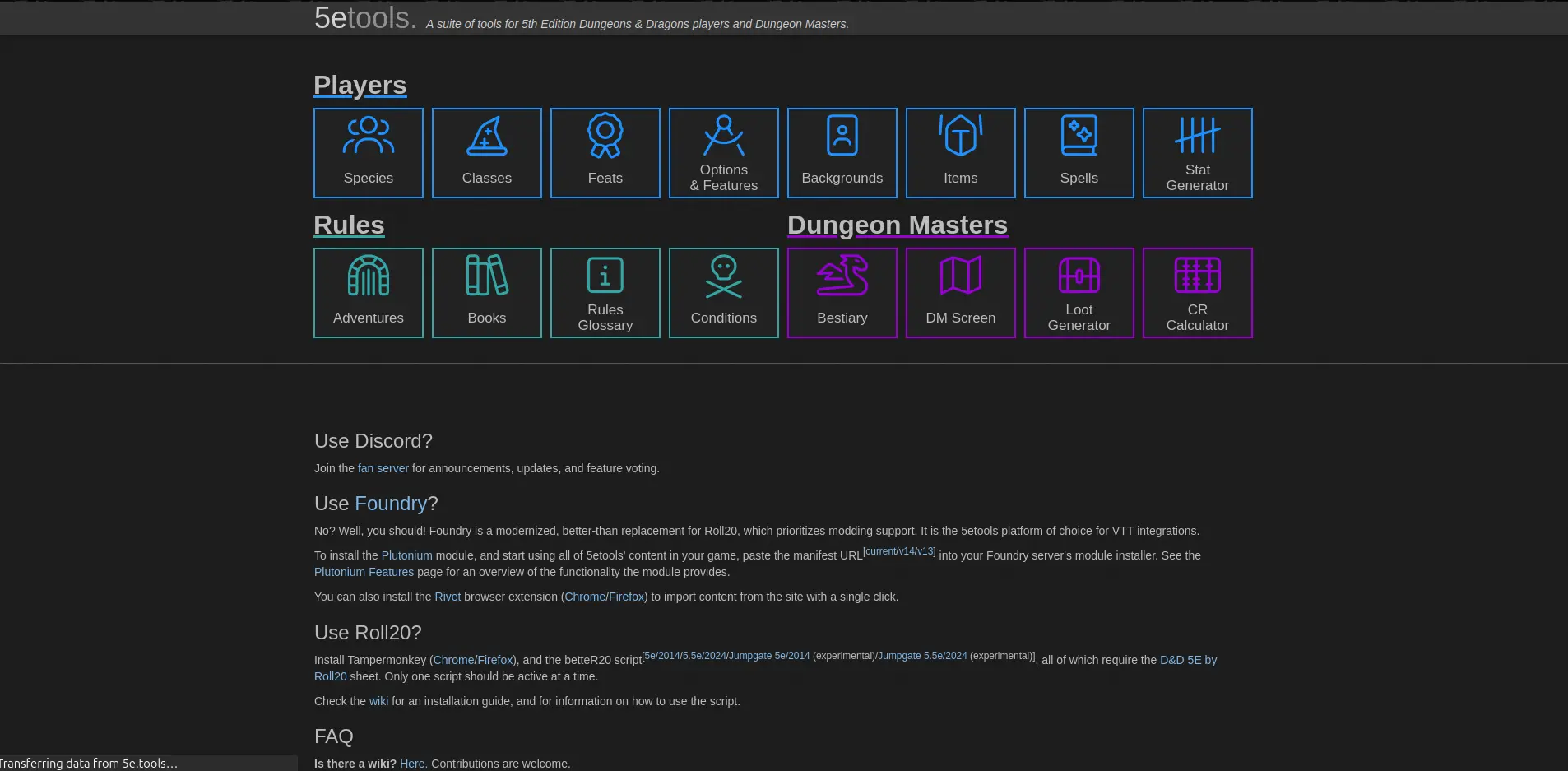
Alright, time to get to the fun part. Creating the character sheet. Most dungeon masters will have you use D&D Beyond or the built-in character sheets for the VTT that you're dungeon master is using for your adventure. Again, you will need to read the adventure page closely for these details. You don't want to miss them. Also, it helps because you might not like Foundry or Discord. So knowing what tools are used and what you like and don't like help. But back to the point here, you see what the process is for creating your character sheet and get to it. If your using beyond, it's really straight forward. They literally walk you through it and explain all the different stuff and what everything does. You could spend hours building sheets on there for fun cause there's no limit on how many characters you have just chilling on beyond. If you have to use the built-in sheets, your best bet unless the dm is assisting/has compendiums(books) is to use 5e.tools. You can grab all the character info you need as you build but you're also building without a easy guide like you would on beyond. My suggestion is slowly buy up books for character stuff and build your sheets there. Show them to the dm for approve and work with the dm for however you need to import your sheet into the game. Either by a web tool or copy & paste the info.
You still need some resources to figure out how to create that character sheet?You found your dungeon master, created your character, and now you're ready to go play some Dungeons & Dragons. We're all really proud that you made it this far. But you're most likely waiting for your first session right now. While you're waiting, now is the time to talk to the other players. See what info everyone is sharing about their characters. Decide what you want to keep a mystery til later about yours. And get an idea of who you're playing with. This is truely a great time because it gives everyone a chance to form bonds and decide how their character will handle this new party.
Most of the time, the dungeon master will have a chat group or discord server. Online or in-person, there is always some sort of chat group for everyone to talk so that if anything comes up or there needs to be any group announcements, there's one place to tell everyone as a group rather than the dm sending out individual texts to everyone. If you're playing online, Discord can be a lot of fun.
Step 5: Game Night - Session #0So it's time for game night and your skimming back through this blog post. Getting ready for the big night and wondering if you're ready for this. Honestly, you might not be ready and that's okay. Because once the dungeon master makes his grand "introduction" at start time, there's no turning back. Your mistakes will shape what sort of player you become. Your dungeon master is going to be happy to guide you if you need some assistance understanding rules and how things work. And best of all, the experienced players are going to be so excited to see more people finding interest in their favorite ttrpg. Seriously, everyone gets happy about new players because the bigger the community the more people playing. And with the high rate of cancelations due the (bbeg) big bad evil guy "scheduling", yeah more players in the community means more games and more chances to play each week. If you don't get the scheduling joke, it's just a thing. Something always happens and life causes a player or several to miss a session from time to time.
You made it! You're playing D&D now! You really don't need me anymore.I'm joking! Please come back to check out our campaigns, tools, and blog. We love the traffic and community showing us some love. But if you're reading this right before your first session, Good luck! You're going to do great, even if you make a few mistakes along the way. If you're reading this post and it's not actually game night yet, then keep scrolling! We got more stuff to talk about. Only the players that came back an hour prior to that session should stop here.
What Gear do I Need?
That's a really good question, and we're here to help you with that. Playing in person requires a lot more than it does to play online. And this blog post is focusing mainly towards the online community rather than playing at a table. Sorry guys, but we'll cover that in a different post. There's just so much more to go over between budget and pro setups for players who play at a in-person game. Online is the cheaper option and honestly the budget friendly way to play Dungeons & Dragons with strangers online. If you got a group of friends, then you should grab a table at someone's house and try playing as a group. It's a great experience but all the minitures, books, and other stuff you'll eventually want for your group adds up much faster than it does online.
Which will go into the next thing we're going to cover real quick. Paid Dungeon Masters are something that can be argued about within communities depending on where you go. Personally, I think that online Dungeons & Dragons for strangers should be a paid thing. It's not your friends, or people who are pitching in most of the time. In my free game experiences, its people who are looking to get into the hobby but not spend a single penny. Which in turn hurts the community. It puts a lot of stress on a dungeon master when free players just assumes the dm can go buy a $50 book last minute, or buy cool maps for the campaign. Dungeons & Dragons isn't really cheap, but most of the cost lands on a dungeon master. So, before you decide on free or paid remember that there is a lot of cost involved and try to do something nice to your free dungeon master if you go that route. I'm not saying free is bad, but buy the dungeon master a book, a map pack, or offer a digital gift card to something they like. I'm just saying, don't forget that your dungeon master takes on a lot financially and knowing you genuinely appreciate them being the dungeon master helps their morale.
What You'll Need for Game Night
Computer

Lenovo Business 15.6" FHD Laptop
A roomy 16" workhorse with 16GB of fast DDR5 for smooth everyday multitasking
Check Price
Lenovo ThinkPad P14s Gen1 Laptop
A compact 14" mobile workstation with NVIDIA Quadro graphics and legendary ThinkPad build.
Check Price
Lenovo IdeaPad Slim 3X
Snapdragon-powered touchscreen laptop built for fast, cool, efficient everyday work.
Check PriceHeadset

Razer BlackShark V2
An esports-favorite wired headset with crisp 50mm drivers, THX Spatial Audio, and a clear detachable mic.
Check Price
JBL Quantum 360X Wireless
Lossless 2.4GHz wireless gaming headset with a detachable boom mic and up to 22 hours of battery life.
Check Price
HyperX Cloud III
A wired headset built for long gaming sessions, with angled 53mm drivers, a clear 10mm mic and memory foam cushions.
Check PriceNotebook

Lined Spiral Journal Notebook
An A5 hardcover spiral journal with 150 numbered, college-ruled pages of thick 100 GSM no-bleed paper, sized to carry to every session.
Check Price
Mazeran Campaign Journal for DnD 5e
A 3-pack of D&D 5e player journals, each with character sheets, spell pages, and NPC and quest trackers, so every player can track one full campaign.
Check Price
PAPERAGE Lined Journal Notebook
A classic Paperage hardcover journal with 160 lay-flat, college-ruled pages of thick 100 gsm paper, plus an inner pocket, ribbon bookmark, and elastic band to hold your session notes.
Check PriceDice (Optional)

Electronic Dice - D20
A Bluetooth smart D20 that lights up and plays sounds on your rolls, like flashing red on a nat 1 or rainbow on a crit, and can send results to your virtual tabletop.
Check Price
GoDice D20 Connected Polyhedral
A Bluetooth smart D20 that reads your physical roll and sends the result straight to Roll20, Foundry VTT, or Discord, so you can roll real dice in online games.
Check Price
GoCube Ultimate GoDice Pack 6
A full set of 6 Bluetooth smart dice with snap-on shells that turn them into D4, D8, D10, D12, D20, and D100, so the whole party can roll real dice and send results to Roll20, Foundry, or Discord.
Check PriceWhat is a VTT?
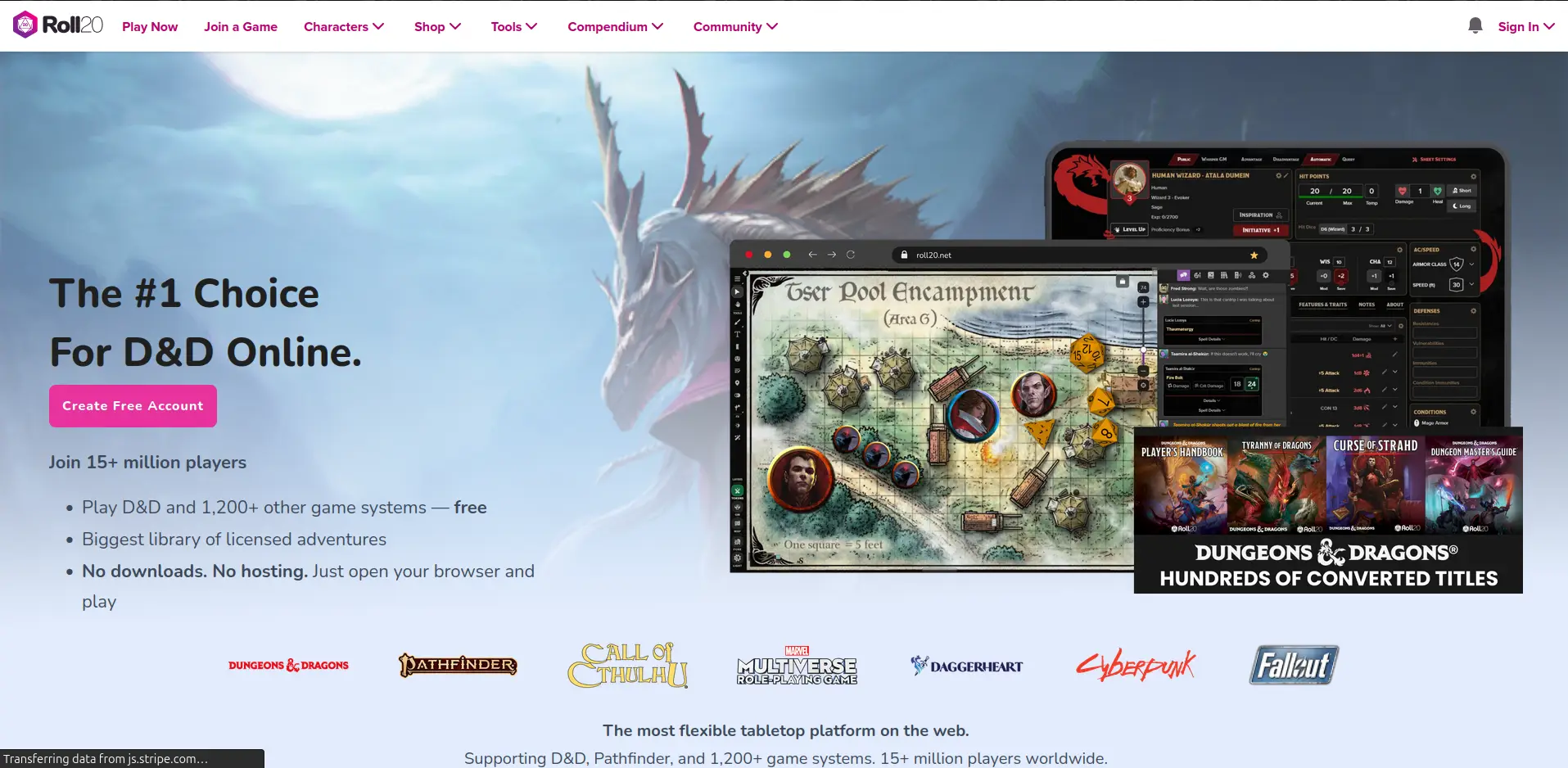
A VTT, or virtual tabletop, is an online version of the gaming table. It gives your group a shared map, tokens for characters and monsters, character sheets, and a dice roller in one place, so you can play D&D from anywhere. Popular VTTs include Roll20,
Foundry VTT, and Owlbear Rodeo, and many groups use Discord alongside them for voice chat.
Smart dice like Pixels and GoDice connect to your VTT over Bluetooth. You roll a real die on your desk, and the result appears on screen for the whole table. You keep the feel of rolling your own dice without anyone asking you to "trust me, it was a 20."
I'm personally a huge fan of Foundry VTT for a variety of reasons. Each VTT has it's own advantages and disadvantages that you might consider looking at from both a player and dungeon master side of things. If you're looking for an adventure on startplaying,
they do have filters to help ensure the dungeon master is using the VTT you prefer. This is great for someone who has tried one or more and knows exactly which one they're happy with using. Some people don't like to switch once they've found one they like.
If you've not found your favorite yet, then I highly recommend that you give Foundry a try. If you're a brand new player to D&D in general, it's going to make learning the game go a lot smoother. If you're an experienced player but new to online, you will feel
more like a real table experience than you will with other basic 2D VTTs. With the right dungeon master and tools, Foundry can almost bring the experience to life with all the modules that people create for it. I actually have a few that do special effects for
traps, tokens, and so on. It gives a flair to when someone goes into rage and it actually a special rage effect.
More about Foundry
Foundry VTT is a lot different than the rest of the VTTs offered to the TTRPG community right now. It has a lot of features that these other ones just don't offer. It's a company ran by people who love TTRPGs and pursued this idea of creating a better one after seeing the other options on the market. They did a good job too, because Foundry has one of the biggest followings I've seen in 3 years of online D&D. A lot of people have a lot of good things to say about this one. But like all things, some people just don't like it. And that's okay. This is why places like startplaying give you a vtt filter option when you know which vtt you just do not like.
The Cost
Well, this is actually the best part of most VTTs right now. There is no cost of you're just a player. It's completely free to use for the players in the party, but the cost exists. The dungeon master of your party will have to pay $50 for the software and host the
game/software somehow so that everyone can connect to his/her VTT "server" and interact with the maps. This can be very easy or very tricky. If you're using Foundry, don't go for a dungeon master who is trying to host foundry from their own computer. You can do it,
but it's the same as trying to host minecraft. It's not going to be great, and their internet connection isn't designed to host 4 - 8 people trying to connect to their personal computer. Plus its a lot of tech stuff. The easier path, and what you should be looking for,
is a dungeon master who pays for a foundry server. You should actually ask them "how do you host the foundry server" when you hear that they run foundry. I definitely would, because then i'm not wasting my time getting ready for the campaign just to find out that we're
going to have connection issues nonstop. So remember, at the price of it being free... the cost is on the dungeon master.
The modding
Modules are what Foundry calls "mods" for the software. It's a fantastic community of people who create just about anything you can imagine. The creativity and what they can do with foundry has shocked me time and time again. I think i've seen everything, and then one of the
popular module makers comes around and makes something i've never seen before. Want a mini-game for lockpicking? Yeah they got that. Need to import sheets from beyond? Yup. But let's face it, that's some stuff that will confuse a new player. For the dungeon master randomly reading,
you should try foundry for your players! For the new player, it has a lot of cool modding abilities that you'll see from dungeon masters doing their setups.
User Friendly
It's very user-friendly, but honestly as a player, most of these VTTs are. They're really designed to make the players trying to learn how to use them become a very fast and effortless transition. And once you learn one, the rest come easier to figure out. It's typical that it takes a few
sessions but the learning curve is pretty fast. There are also a ton of resources out there, especially for foundry, on how to use it. Youtube is a great tool for this.
Free or Paid Games?
There is always a huge debate over this, and as a new player you will hear it a lot. Listen, at the end of the day you are paying your dungeon master no matter what. Some dungeon masters love the social aspect of D&D, and others ask you to bring snacks and drinks. You might even have one who asks if people can donate towards a book, minis, or something that could improve the experience. Nothing in life is free, and when we transitioned from table to computer the illusion that d&d is free started to vanish. You're no longer playing with a group of friends who saved up for the stuff to play. You're online with strangers who just might become new friends, and someone who spends countless hours trying to create a memorable campaign for all of you. So i always lean on the side that paying is justified because if i was playing in person i'd offer to pitch in somehow. So it's just doing my part to pitch in.
Startplaying
So this is a great place to search for a paid game, but i need to warn you about those big scary price tags. $30+ for a game can quickly scare off a new player. It makes you feel like that's where the good games are and the $10 dungeon master is going to obviously suck if $30 is the average in 2026.
You need to understand though that these dungeon masters who charge that have been around for a while. They've worked up to that price. They have built up a collection of stuff to enhance their games yes, but it doesn't mean that you'll dislike a $10 game. But if you're nervous about the price in general
or feel like $15/week is a lot of money when you might not like d&d, you can try one-shots. It's a great way to try it out and see if you even like d&d. Startplaying also has other features for helping new players move into the game.
Free Games
Free games online are alright, but expect a 50/50 chance that it might not go well. They're very hit or miss, and when a dungeon master has no references, reviews, or anything to show they're not a bad dm with a ton of bad reviews.... you kinda just guess when you're new. It's different when it's your friends
or a local game in my opinion. I've played some really fun free campaigns, but i've also played some i've not been such a fan of. Which can happen with paid games but places like startplaying offer ratings to help see what people think of the dungeon master.